

The headline came across my feed the way these things do, between a school reminder and someone’s vacation photos. “Gen Z is Officially Less Intelligent Than Millennials.” I felt it in my stomach before I thought anything at all. I have kids. I teach kids. A sentence like that goes straight past the analytical part of the brain and lands somewhere lower.
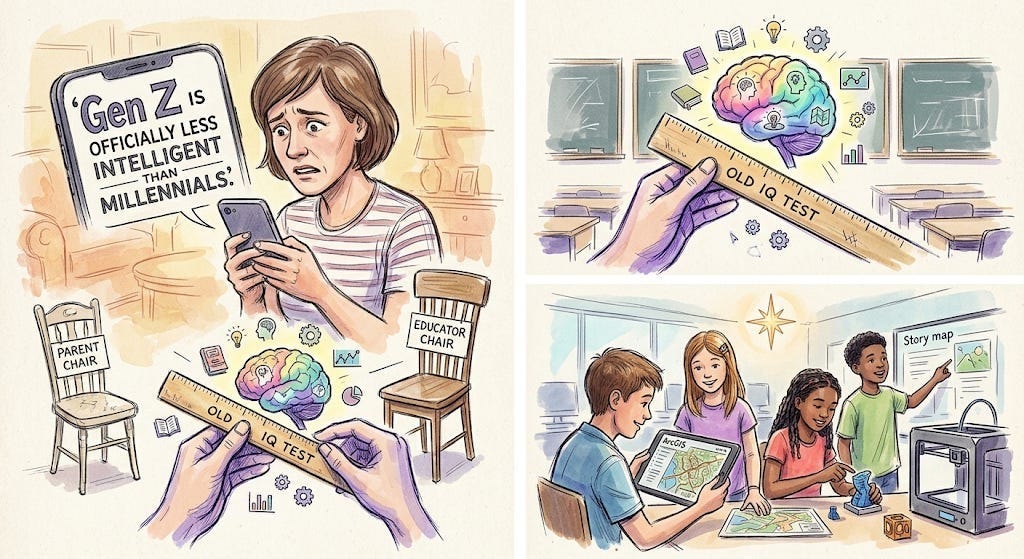
That is the parent chair talking. Then I sat down in the other one, because the educator in me has learned to be suspicious of a headline that arrives already this certain. I decided to read the actual argument underneath it. I want to share what I found, from both chairs, because I think the honest version is more useful than the scary one.
Where the claim comes from
The headline traces back to Jared Cooney Horvath, a cognitive scientist who opened his testimony to the U.S. Senate with almost exactly that line: our kids are less cognitively capable than we were at their age. He backs it with real data. For most of the last century, IQ scores rose, generation after generation. That long climb even has a name, the Flynn effect. Then, around the turn of this century, in some countries, the climb stopped and began to reverse.
That reversal is real, and it deserves to be taken seriously. Horvath’s explanation is that the cause is screens. The tools we hand kids, he argues, do the thinking for them, and thinking that gets outsourced eventually withers.
I want to start with real respect. I have heard him speak, I have listened to several of his podcasts and webinars, and his grasp of the neuroscience is impressive and compelling. I have learned much from him.
Which is why I want to name something carefully. I wonder if a deep skepticism of technology is doing some of the steering here, because it took him from a correlation to “screens did it” faster than I think the evidence warrants.
Let me be honest about my own standing. I am not a neuroscientist. On brain science itself, I defer to the people who have given their careers to it, and he is one of them. What I bring is a different kind of expertise. Thirty-five years in education, and a lot of that spent trying to hold Mind, Brain, and Education research and technology in the same hand at once. That balance is genuinely hard, and it does not reduce neatly to a post. But if those years taught me anything, it is that intentionality is everything, and that leaning into all of what these tools make possible matters as much as guarding against what they cost.
Here is the version he didn’t write.
Start with his own concession
Horvath says, correctly, that an IQ score isn’t the same thing as intelligence. It measures something narrower. Call it school-ability, the particular kind of thinking that formal schooling has rewarded for a very long time. He is right about that, and I think the point is bigger than he lets it be.
If an IQ score is basically a mirror of school, and the reflection changed, the first honest suspect isn’t that kids’ brains shrank. It is that school changed.
And it did. Many of us spent the last few decades deliberately moving away from memorization and coverage and timed regurgitation, toward deeper projects, real-world problems, and learning that transfers. We did it on purpose, because we believed it was better. But the tests we use to measure kids mostly didn’t move with us. So some of what looks like a decline may really be a growing gap between an old ruler and a new definition of learning. Perhaps the ruler got out of date, not the kids.
The part about timing
There is also a problem of dates, and it matters for parents especially, because it takes some of the fear out of the story.
The best-known studies of this reversal find the drop beginning with people born in the mid-1970s. Those are adults now in their late forties. They grew up without smartphones, without tablets, without a device in every backpack. If the decline was already underway in a generation raised with none of the technology being blamed, then that technology can’t be the thing that started it. Researchers also hypothesize that this slowdown occurred because industrialized nations have reached a point of diminishing returns regarding nutrition, basic health, and access to primary education, all factors attributed to leading to the Flynn effect.
Here is the part I did not expect to find. The World Economic Forum put out a report in June 2026 that takes the risk of AI to young minds very seriously. It has a whole section called cognitive atrophy. And even that report dates the decline to the early 2010s and pins it on a tangle of causes, smartphones, social media, the pandemic, and more. Its actual conclusion is careful. AI, it says, “may exacerbate existing weaknesses by reducing opportunities for active cognitive engagement rather than being the primary cause of these declines.” The source most alarmed about AI and the developing brain still will not call it the cause.
You can still argue screens are making a preexisting trend worse. That is a fair thing to try to prove. But it is a smaller, more careful claim than the headline, and it is not the one being sold.
We have judged a generation this way before
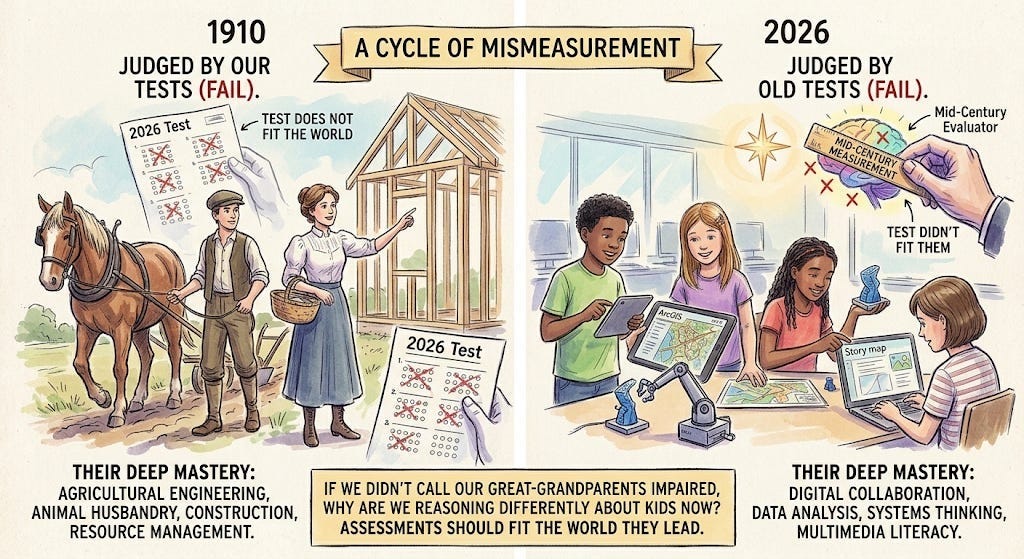
I keep thinking about people who were young in 1910. They were not less capable than we are. They had deep mastery over a world our tests would have scored badly, because our tests measure our world, not theirs.
We don’t call that generation impaired. We say the test didn’t fit them. I am not sure why we would reason any differently about kids now. Our assessments may not fit this world either. Measuring a child in 2026 against a mid-century idea of what a smart student looks like, and then calling the gap a decline, is the same mistake we would never make about our great-grandparents.
Where he is partly right
None of this means that handing a kid a screen and walking away is fine. It obviously isn’t.
Struggle can be where learning happens. That part is true and worth defending. But not all struggle is the good kind. Some of it is just a wall that wastes a child’s attention on the wrong thing. The real work, for teachers and parents both, is deciding which difficulties are worth keeping and which ones are just noise. That is a design question, and it is the one his argument keeps stepping around.
The same report says it in one sentence I keep coming back to. “Learning outcomes will not be determined by technology itself, but by the conditions in which it is deployed.” Its whole framing is that the question is not whether AI will shape our schools, but whether our schools will shape how AI gets used. That is a claim about design and intention. It is not a claim about the ceiling of a child’s mind.
I will admit something. Reading the comments under his piece, I felt a little sad, because “we are using these tools badly” might really be a big part of the story. And if it is, that is on the adults, not the kids.
I see it in our own reflexes. Take Jonathan Haidt’s work, which shaped so much of the phone conversation. His argument actually had two halves. We have underprotected kids in the digital world, and we have overprotected them in the real one, where the value of real, unstructured play quietly got hollowed out. Schools heard the first half and moved fast. We took the phones away. We spent real money on Yondr pouches to lock them up. But we mostly left the second half alone. We didn’t give kids back the independence and the free play that were supposed to come with it. Our reaction was to gut the technology, not to sit with the whole argument.
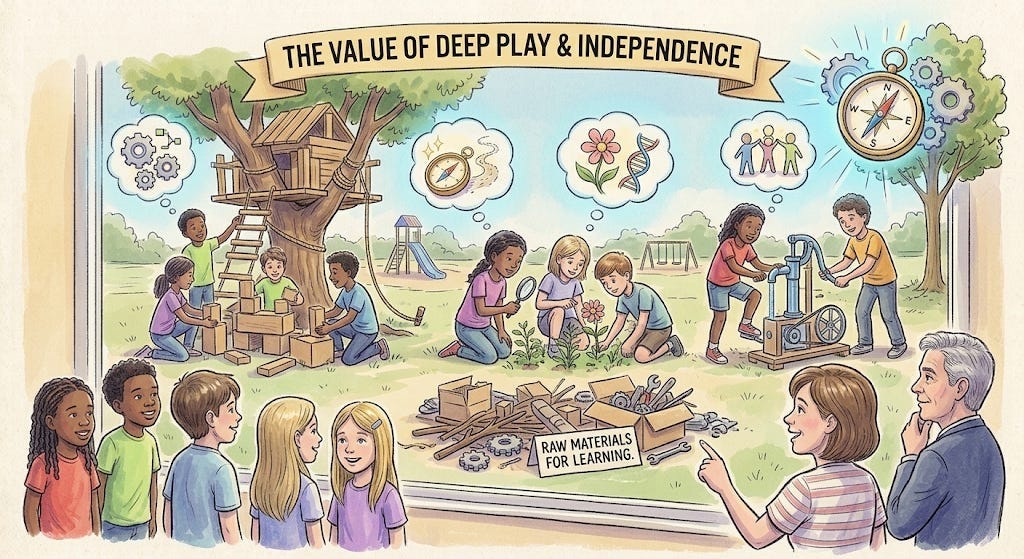
I worry we are about to do it again. Horvath’s claims are pulling us toward how much screen time, when the harder and more honest question is how it is being used.
What it looks like when it is done well
I have been fortunate to use technology in ways I believe genuinely deepened learning.
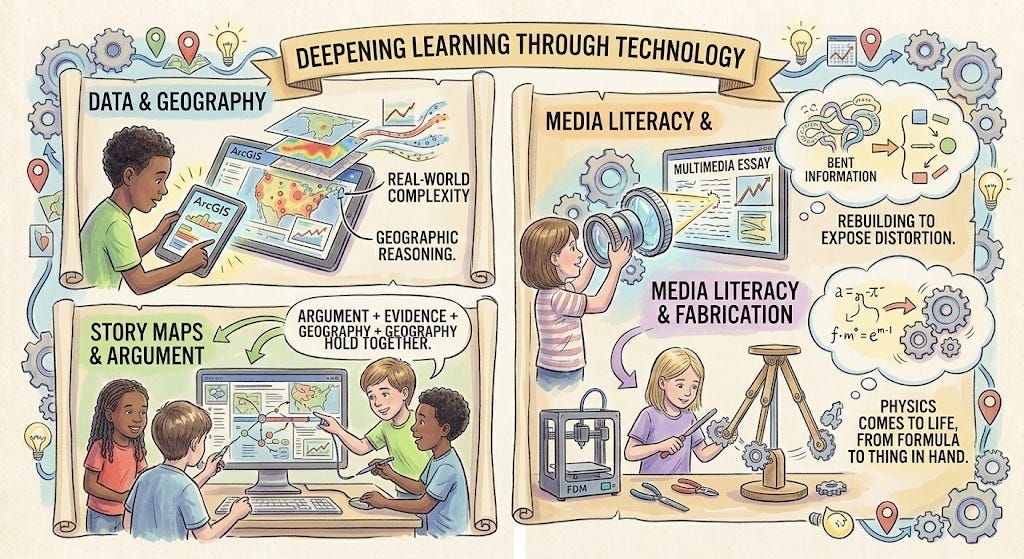
Students used ArcGIS to analyze large data sets for trends across a geographic map, reasoning with real complexity instead of a tidy worksheet. They built Story Maps to tell a story, where the argument, the evidence, and the geography all had to hold together at once. They made multimedia essays to teach themselves media literacy, learning to expose how information gets bent by rebuilding it instead of just naming that it happens. They brought physics concepts to life through digital fabrication, where an idea stopped being a formula and became something they could hold in their hands. And, to be clear, they engaged with stories in print, annotated primary source documents, and solved math problems with their peers both on paper and on vertical, non-permanent spaces. They learned in intentionally designed analogue and digital spaces as they prepared for a future that will include both.
That same report also lands the hopeful version of this in a single line. Basic literacy, the ability to read and write, has long been the foundation of education. AI and digital literacies, it argues, are now essential extensions of it. Not a replacement for reading and writing. An extension of them. And the reason to teach them is to grow learners who are, in its words, “not just consumers of AI, but confident, critical participants.” That is the whole aim in one sentence. You do not get there by keeping the tools out of the room.
I want to be honest about two things at the same time.
The first is that this digital work probably did not prepare those kids for the way we still run external tests. You cannot bubble in a Story Map. If you measured these students on the old instrument, a lot of their real growth would be invisible. That is exactly the mismatch I keep pointing at, except now it is sitting in my own classrooms. I made that trade on purpose, because I thought the deeper thing was worth more than the measurable thing. And the measurable thing is still attended to.
The second is that none of the digital could have been done without a computer. You cannot hand-plot thousands of data points across a map to find the trend hiding in them, or build an interactive Story Map, or take a piece of media apart by rebuilding it, on paper. The screen was not a shortcut around the thinking. It was the only door into it. And the very same work built skills that may matter enormously in the world these kids are going to lead. Reading a large data set honestly. Telling a true story with evidence. Seeing how media gets manipulated from the inside. Making an abstract idea real.
So when someone tells me screens erode thinking, I picture those rooms, and I don’t recognize the claim.
That is also my one real invitation to Horvath, and I mean it kindly. Rather than another warning, show us the cases where learning with these tools created something that could not happen without them. If you look hard and there truly aren’t any, say so and defend it. But if there are, then the honest claim isn’t “screens erode thinking.” It is “we are using them badly.” That is a design failure, not a cognitive one, and it is a far more useful thing to write about, because it is something we can actually fix.
So what does this mean at your kitchen table
If you are a parent, here is what I would take from all of it.
You do not need to panic about a headline. Your child is not a broken version of you. But you are right to care a great deal about how the tools in their life are used, because that is where the real difference lives.
The thing to watch for is not screen time as a number. It is whether the screen is doing the thinking or the child is. Those look completely different up close. When a kid uses a tool to reach something they couldn’t reach alone, and still has to wrestle with it, that is learning. When the tool hands them the answer and they move on, that is not. You can usually feel which one is happening by asking your child to explain what they made and why. If they can walk you through the hard parts, the thinking was theirs.
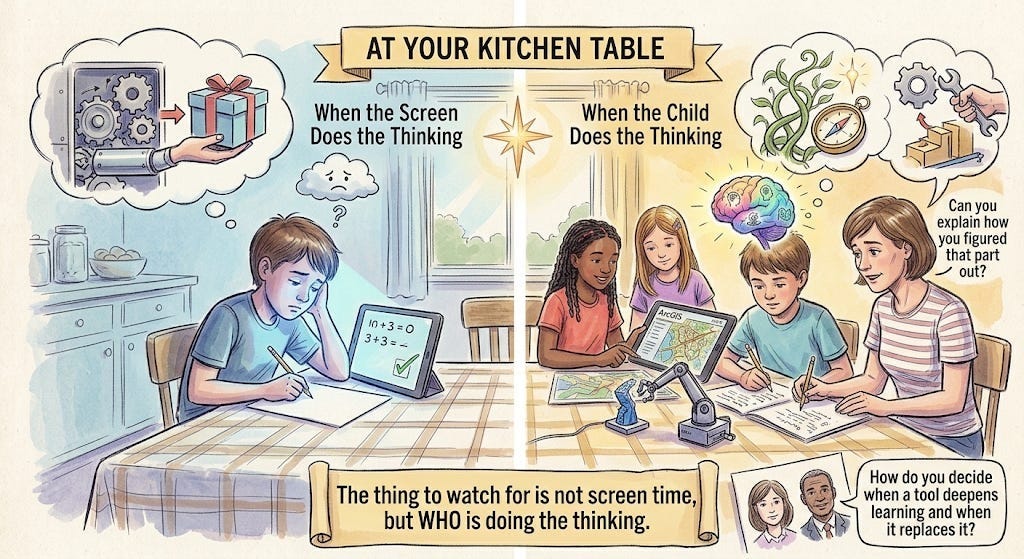
And it is more than fair to ask your child’s school how they think about this. Not “do you allow devices,” which is the wrong question, but “how do you decide when a tool deepens learning and when it replaces it.” A school that has a real answer to that is doing the work. A school that only has a rule is not.
Both chairs
I sit in both chairs on this one, and I am not going to pretend they agree.
The parent in me still felt that headline in her stomach, and still will the next time. The educator in me has watched these tools do things in the right hands that I could not have given kids any other way. I don’t think those two truths cancel out. I think holding both of them at once, honestly, without letting the fear or the hope win outright, is most of the job.
What keeps me steady is the same thing either way. Keep the student the North Star. Not the test, not the tool, not the headline. The kid.
I might be wrong about some of this. But I don’t think the case is closed the way that headline closed it.
Wonderful post, Elizabeth, thank you! Glad to learn about the Flynn Effect. Your 'better question" of “how do you decide when a tool deepens learning and when it replaces it" is 100% on point. Reminds me of Phil Schlechty and “Working on the Work.” Who is doing the most work in the classroom? That person or those folks are probably doing the most LEARNING. Pedagogy and engagement matter. And so do questions!